“The Wolf and the Seven Little Goats” through the eyes of cybersecurity
An analysis of the Brothers Grimm tale (1812) as a full targeted-attack chain — from reconnaissance and social engineering to MFA bypass, initial access and recovery.
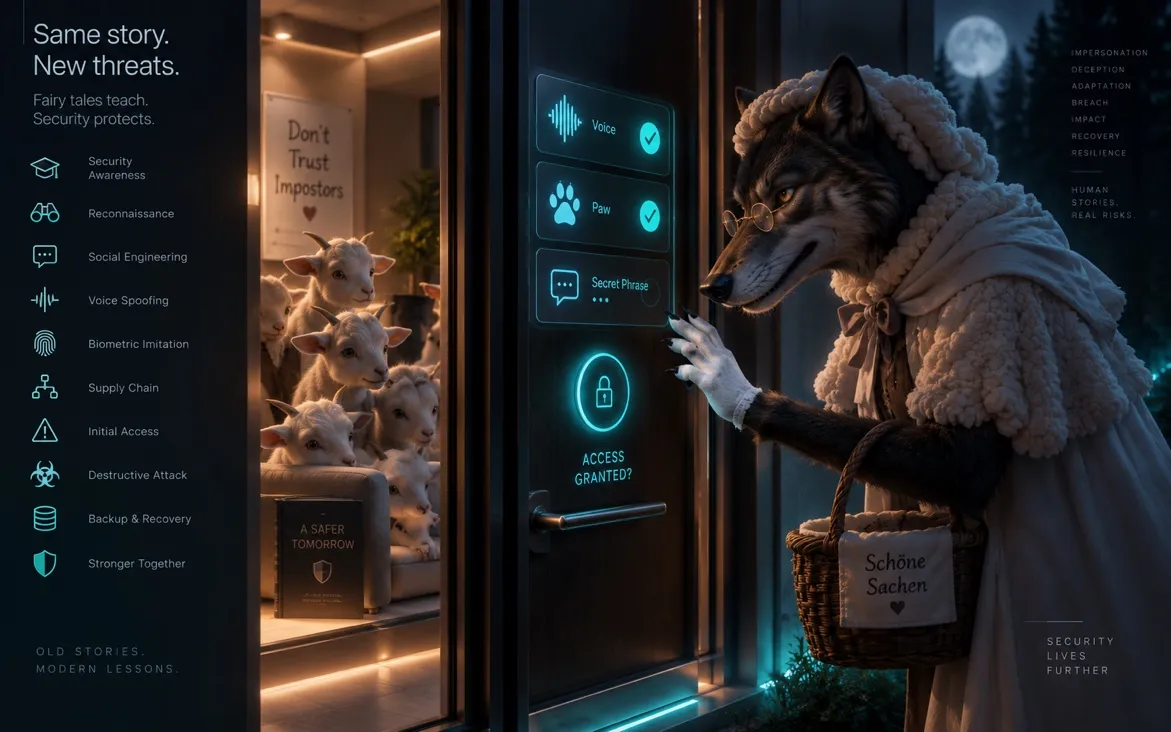
Disclaimer
I am not a practicing cybersecurity professional – I only have practical IT experience and a personal interest in the field. And this is not a scholarly work on information security, but a popular analysis-analogy, a way to look at a classic plot through the prism of modern terminology and enjoy how accurately a 200-year-old text describes the mechanics of social engineering.
A few clarifications about the method:
- Publication. The basis is the very first edition of the fairy tale – Der Wolf und die sieben jungen Geislein, 1812 (Erstausgabe), by the Brothers Grimm. Later editions differ in details of the plot and dialogue, so some of the observations below may not work for other versions. The original in German is on Wikisource; the text is also added in the attached document.
- The nature of comparisons. Cybersecurity terms are used here as analogies and illustrations, not as strict one-to-one technical comparisons. The tale is not a technical incident, and some parallels are intentionally stretched for clarity.
- Links. Almost every special term below has a hyperlink to Wikipedia or to materials from recognized companies and organizations in the field of cybersecurity (CrowdStrike, OWASP, NIST, MITRE, Fortinet and others) - so that readers unfamiliar with the terminology, and there may be many of them, can immediately check the definition from the original source.
- Original text. The 1812 tale itself is in the public domain; the author’s text of the analysis, structure, and comparison are the original work of the author of this article.
Introduction
I suggest looking at the Brothers Grimm fairy tale “The Wolf and the Seven Young Goats” through the prism of cybersecurity.
As I noted above, the analysis is based on the very first edition of the fairy tale, which you can read in the original language at the link (or use a translator).
This is not just a fairy tale about social engineering. This is almost the entire lifecycle of a targeted attack:
reconnaissance → impersonation → failed authentication → information leakage → adaptation → MFA bypass → initial access → impact → incident response → recovery
So let’s look at it sequentially.
Content
- Security Briefing before leaving home
- How many authentication factors are there in this family?
- “Ich bin eure Mutter” – the first attempted invasion
- How the wolf knew what to say: the intelligence hypothesis
- The first refusal – and the first information leak
- Chalk: Voice Biometric Factor Forgery
- Second attempt and second Oracle Authentication
- Baker and Miller: Third-Party Coercion
- White paw: presentation attack on biometric sensor
- Doors is opened: initial access
- The wolf inside: wiper-like behavior without network segmentation
- Goat in a watch: isolated backup
- Mother returns: Incident Detection
- Thread, needle, scissors: incident response toolkit
- The wolf falls asleep in the meadow: OPSEC failure
- Rescue operation: data compromised but not lost
- Stones instead of goats: active defense and deception
1. Security Briefing before leaving home
“liebe Kinder, ich muß ausgehen und Futter holen, wahrt euch vor dem Wolf und laßt ihn nicht herein, gebt auch Acht, denn er verstellt sich oft, aber an seiner rauhen Stimme und an seinen schwarzen Pfoten könnt ihr ihn erkennen […]”
The first thing we see is security awareness training in its purest form. Mother Goat actually conducts a pre-incident security briefing before leaving the “object” unattended. She:
- defines threat actor – Wolf;
- describes his TTP (tactics, techniques and procedures) – “er verstellt sich oft” (“he often disguises himself/disguises himself”);
- sets a security policy – “laßt ihn nicht herein” (“don’t let him in”);
- informs indicators of compromise – “rauhe Stimme” and “schwarze Pfoten” (rough voice and black paw);
- describes impact – if an attacker gets inside, the consequences will be catastrophic (“so frißt er euch alle miteinander”).
The phrase “er verstellt sich oft” is particularly telling. In modern terminology, this is literally a warning: do not trust the declared identity, the opponent is capable of impersonation.
2. How many authentication factors are there in this family?
The briefing shows that the family de facto uses multi-factor authentication – verification using several independent features at the same time.
But here it is worth being precise. Classic MFA factors belong to three different categories (NIST SP 800-63B): something you know, something you have, something you are. Voice and black paws are both physical/biometric features, that is, they both belong to the same category, something you are. These are not two independent factors in the strict sense of MFA - they are rather two independent signals of the same category, and that is why they were both able to be faked using the same method (changing one’s own physical feature).
The secret phrase (passphrase), which could become a real something you know and a third, category-independent factor, is not heard anywhere in the 1812 edition – the mother goat does not tell it to the children during the briefing.
Therefore, it is more accurate to formulate it this way: two-factor authentication in appearance, but one-category in essence (two signals, one category) – potentially three-factor, if there was a previously agreed code phrase, which the text does not provide evidence of.
3. “Ich bin eure Mutter” – the first attempted invasion
“liebe Kinder, macht mir auf, ich bin eure Mutter und hab’ euch schöne Sachen mitgebracht.”
The first attack – and several techniques at once:
- Identity spoofing / impersonation – the wolf claims someone else’s confidant: “Ich bin eure Mutter”.
- Pretexting – this is not just a false statement, but an entire fabricated legend (I am your mother, I have just returned, I have gifts for you) that creates a context that lowers vigilance.
- Baiting – “schöne Sachen mitgebracht” (“brought good things”) – the promise of a reward to incentivize a targeted action (open the door). A classic from the textbook of social engineering.
Assuming that the mother’s address to the kids was known only to the family, the wolf seems to be using some kind of stolen knowledge for authentication. But that’s just a guess: in the first edition, no passphrase is heard anywhere before it is first uttered by the wolf himself. And how did he even know what to say?
4. How the wolf knew what to say: the intelligence hypothesis
The text does not directly say that the wolf watched the mother and learned what to say to the kids. Let’s try to reconstruct the attack.
The wolf, at the moment of first approaching the door, already knows:
- that the mother has left home;
- that the children are left alone;
- how to address them (“liebe Kinder”);
- what legend to use (“I am your mother, I have gifts”).
That is, the attacker has obviously conducted prior targeted reconnaissance.
Possible ways to obtain this information are passive observation or eavesdropping (in the human, not network sense - here it is more OSINT/object observation than the classic “shoulder surfing”,
which refers to eavesdropping on the entry of credentials and is less suitable here). But this is precisely the hypothesis-reconstruction: there is no direct evidence of observation in the text.
5. The first refusal – and the first information leak
“unsere Mutter bist du nicht, die hat eine feine liebliche Stimme, deine Stimme aber ist rauh, du bist der Wolf, wir machen dir nicht auf.” - ….. you are a wolf, and we will not open the door for you.
The first authentication attempt failed, the attacker was exposed. A great example of authentication in action - the system worked.
But here the kids make a critical mistake: they tell the attacker the exact reason for the refusal.
This is not just a “password hint” like “the password is incorrect, here’s a hint”. It would be more accurate to call it information disclosure through the authentication oracle: instead of answering in a general way
ACCESS DENIED– the system actually responds –
ACCESS DENIED: INVALID VOICE.This is a very modern problem. A poorly designed login page that distinguishes between the responses “user exists, but password is incorrect” and “incorrect username or password”
gives an attacker just such an unnecessary signal – a classic case of user enumeration
and information disclosure through an error message. “Authentication oracle” here is not the official name of the vulnerability, but a descriptive metaphor for this class of problems: when the authentication mechanism inadvertently tells the attacker which parameter needs to be fixed.
6. Chalk: Voice Biometric Factor Forgery
“Der Wolf ging fort zu einem Krämer und kaufte sich ein groß Stück Kreide, die aß er und machte seine Stimme fein damit.”
The wolf works on mistakes – physically alters his own voice by eating chalk. It is worth distinguishing between two similar, but not identical, concepts: this is not voice cloning/deepfake in the modern sense – the synthesis of someone else’s voice by technical means – but rather the masking of one’s own voice under the characteristics of the target voice. However, the conclusion is the same in both cases, and this is the value of the analogy:
This is not a secret if the biometric characteristics can be replicated or faked.
This is a fundamental problem with voice authentication, which the tale of 1812 illustrates
two centuries before the term «deepfake» appeared.
7. Second attempt and second Oracle Authentication
The wolf returns with a new, “corrected” voice and successfully passes the voice-check. But he accidentally shows his black paw in the window.
“unsere Mutter bist du nicht, die hat keinen schwarzen Fuß, wie du; du bist der Wolf, wir machen dir nicht auf.”
The second security control worked – access was denied again. But the kids again voiced the exact reason for the denial:
VOICE = VALID · PAW = INVALIDThis is almost a classic adaptive attack against an authentication system:
the wolf does not try to brute-force the system randomly.
It methodically carries out the cycle probe → feedback → modify attack → probe again - essentially a manual,
slow analogue of what in penetration testing is called iterative testing of resistance controls (penetration test).
8. Baker and Miller: Third-Party Coercion
Since it was not possible to bypass the paw check on its own, the wolf turns to third parties for help:
Wolf → Bäcker → Müller → Target“Bäcker, bestreich mir meine Pfote mit frischem Teig” … “Müller, streu mir sein weißes Mehl auf meine Pfote.” Der Müller sagte nein. – “Wenn du es nicht thust, so freß ich dich.” Da mußte es der Müller thun.
The attacker engages a third-party vendor to create the attack component.
If the baker fulfills the request without resistance, then the wolf resorts to direct coercion
and threats of physical violence against the miller - it is more accurate to call it third-party coercion:
“Wenn du es nicht thust, so freß ich dich”. Here, the miller is not a willing accomplice, but a victim of coercion, making an instrument of attack under threat.
9. White paw: presentation attack on biometric sensor
The wolf replaces the black paw with a snow-white one by sprinkling flour on top of the dough. This is a classic concept of a presentation attack (ISO/IEC 30107) or biometric spoofing: the attacker does not steal the victim’s real biometric feature (the mother’s real white paw), but forces the “sensor” – in our case, the eyes of the kids – to accept the fake feature as the real one.
The modern equivalent is a low-quality photo in front of Face ID, a silicone fingerprint,
or a deepfake video in front of a facial recognition system.
10. Doors is opened: initial access
“…machten die Thüre auf, und der Wolf kam herein.”
On the third attempt, all tested signals pass:
Voice → PASS · Paw → PASS · Claimed identity → PASSBaby goats open the door. Here is an extremely important lesson in cyber security:
Authentication ≠ Identity.
The system checked the signs, but did not establish the real person.
Each of the checked signals turned out to be such that it could be faked.
And as a result - initial access: security perimeter (door) broken.
11. The wolf inside: wiper-like behavior without network segmentation
Once inside, the wolf doesn’t engage in silent reconnaissance or steal information - he methodically finds and neutralizes everything he can get his hands on. Six of the seven “assets” are compromised.
The closest analogy is wiper malware,
which spreads through a network without segmentation: all “assets” are in one trusted zone (house),
so a compromised perimeter immediately gives access to almost everything.
There is no network segmentation,
no VLAN,
no zero trust strategy.
12. Baby goat in a watch: isolated backup
The youngest kid hides in the wall clock - and survives. In our model, it is:
isolated, offline backup + witness + incident log at the same time.
Six “production systems” were destroyed. But one critical asset remained intact
- and thanks to it, the mother-goat will later be able to establish the cause of the incident.
13. Mother returns: Incident Detection
The mother goat returns home, sees the consequences, and the youngest kid tells what happened. This is:incident detection → evidence collection → event reconstruction → root cause analysis.
In essence, it is a concise post-breach forensic interview:
an element of digital forensics
without any technical tools, only based on the testimony of the only surviving “log”.
14. Thread, needle, scissors: incident response toolkit
The mother goat assesses whether the children can still be saved and takes action. This is the beginning of incident response and recovery:
- Assess whether assets can be recovered;
- Develop a recovery plan;
- Identify the tools needed;
- Move to active remediation.
That is: Preparation → Investigation → Recovery.
And the thread, needle, and scissors are literally her incident response toolkit.
15. The wolf falls asleep in the meadow: OPSEC failure
Having eaten, the attacker loses his vigilance and falls asleep in an open meadow
- finding and neutralizing him is not difficult at all.
This resembles a classic OPSEC failure on the attacker’s side:
after a successful operation, he did not change location, did not make sure that all witnesses were eliminated,
did not remove the traces and, in essence, deanonymized himself by remaining close to the victim.
16. Rescue operation: data compromised but not lost
“Damit schnitt sie ihm den Bauch auf, und die sechs Geiserchen … sprangen unversehrt heraus.”
The mother goat rips open the wolf’s stomach and retrieves all six kids alive and unharmed.
This is an almost perfect illustration of disaster recovery -
“data was compromised, but not corrupted.”
In real life, such a scenario - a complete and painless recovery from a compromise without data loss - happens much less often than one would like.
17. Stones instead of goats: active defense and deception
The final operation is more interesting than a simple “neutralization.” The kids are replaced with heavy stones, the wolf is sewn up – and he doesn’t even notice the substitution right away.
In the metaphor of cybersecurity, this can be presented as active defense or deception technology: the expected state of the system from the attacker’s point of view is “six kids inside”, the actual state is “heavy stones”. Waking up, the wolf feels only “something heavy”, but does not immediately realize the fact of compromise.
The roles are completely reversed: the attacker himself becomes the compromised system.
He heads to the well to drink, loses his balance under the weight of the stones and falls into the water.
The text does not directly state his death, but the context – the kids are dancing with joy around the well – clearly hints at this.
Conclusions
If we were to put the whole story together as a cyberattack chain,
it’s worth making a caveat: the table below is more thematic than a strict correspondence to the phases of the
Lockheed Martin Cyber Kill Chain.
Some of the names used here (“Reconnaissance”, “Initial Access”, “Discovery”) are actually MITRE ATT&CK,
tactics, and not the actual stages of the Kill Chain (Reconnaissance → Weaponization → Delivery → Exploitation → Installation → C2 → Actions on Objectives).
Both frameworks merely inspired the structure below.
| Grimm, 1812 | Cybersecurity |
|---|---|
| Goat warns children | Security Awareness Training |
| The wolf studies the situation | Reconnaissance |
| “I am your mother” | Identity Spoofing / Impersonation / Pretexting |
| Gifts, treats | Baiting / Social Engineering |
| Children check the voice | Authentication |
| Children explain the reason for the refusal | Information Disclosure / Authentication Oracle |
| Chalk | Voice Spoofing (not quite voice cloning) |
| Repeated attack | Adaptive Attack |
| Black paw in the window | Second authentication factor |
| Children explain the mistake again | Authentication Oracle #2 |
| The Baker and the Miller | Third-party coercion (not supply chain) |
| The Miller’s Threat | Coercion / Extortion |
| White Paw | Biometric Spoofing / Presentation Attack |
| The wolf is mistaken for the mother | Identity Impersonation successful |
| The door is open | Initial Access / Perimeter Breach |
| The wolf finds six | Discovery |
| Swallowed everyone except one | Wiper / Destructive Attack |
| The kid hid in the clock | Isolated Backup / Resilience |
| Mother returns | Incident Detection |
| The baby goat tells the story | Incident Reporting / Digital Forensics |
| Thread, needle, scissors | Incident Response Toolkit |
| The wolf fell asleep nearby | Attacker OPSEC Failure |
| The kids are saved | Disaster Recovery |
| Stones instead of kids | Active Defense / Deception |
| The wolf does not notice the changes | Compromise Remains Undetected |
| The wolf falls into the well | Threat Eradication |
What conclusions can you draw for yourself from this:
Security controls worked. The security architecture failed.
The kids correctly detected the attack twice. Voice authentication worked. Paw authentication worked. Security awareness training also worked. The problem was not in the controls, but in the architecture around them: after each unsuccessful attempt, the kids revealed to the attacker the exact reason for the failure. The wolf received feedback, adapted the TTP and attacked again - and inside, where he eventually ended up, there was neither segmentation nor isolation of critical assets (except, as it turned out, one lucky exception).
That is, the Brothers Grimm actually described iterative adversarial testing of authentication controls more than 200 years before the term appeared in cybersecurity.
A lesson that is still relevant today:
Never tell “The Wolf,” whoever he is, which authentication factor he failed.